Foundry Robotics
Robotic Solutions for Foundry Casting Operations
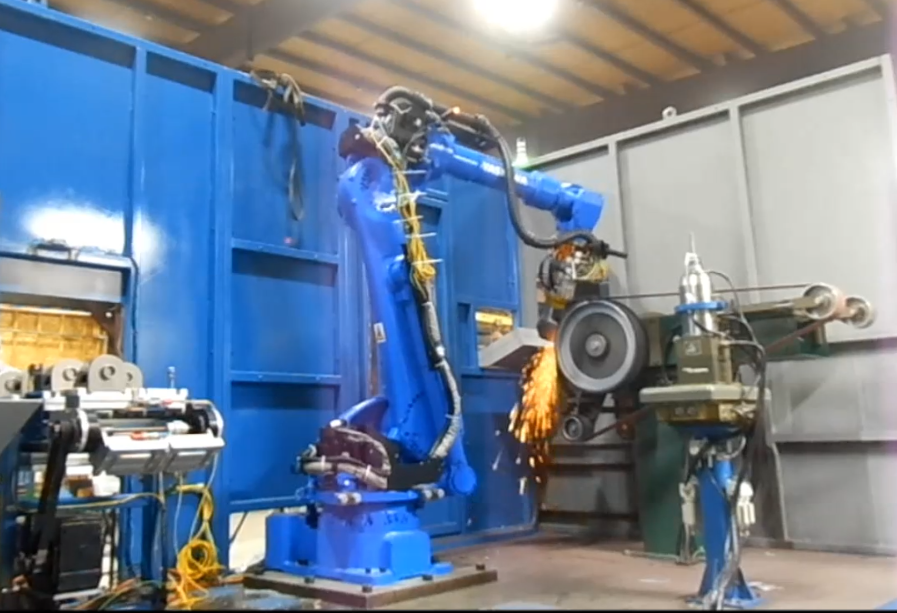
Foundry operations often involve demanding cutting and material-removal tasks that require suitable tooling, workpiece positioning, and repeatable motion. ATD Engineering & Machine develops robotic solutions for casting applications where robot-guided sawing or grinding may fit the production process. Our approach to foundry robotic automation considers casting geometry, tool access, workholding, and the required operation to determine whether a robotic application is suitable. Through application-specific engineering and custom robotic integration, ATD helps foundries evaluate robotic methods for challenging casting-finishing tasks.
How Foundry Robotics Can Support Casting Operations
Robotic systems from ATD Engineering & Machine, LLC can help foundries automate selected operations, reduce direct manual involvement, and achieve more consistent process execution. The benefits of foundry robotic automation depend on the task being automated and the conditions in which the system operates.
- Consistent Process Execution: Robots can repeat programmed movements and operation sequences across production cycles, reducing reliance on manual execution of the same task.
- Reduced Manual Involvement: Robotic foundry automation can take over selected repetitive or physically demanding operations, allowing operators to focus on other production responsibilities.
- Repeatable Cutting and Material Removal: In applications such as casting degating and surface finishing, robotic systems can follow defined tool paths to perform recurring operations. Actual results depend on casting variation, tooling, and process conditions.
- Access to Difficult-to-Reach Areas: Robotic movement can help perform operations on selected casting features that are awkward to reach or process manually, provided the required tool access is achievable.
- Automated Material Handling: Robots can transfer, orient, or position castings as part of an integrated production process, reducing the need for manual handling at those stages.
- Integration with Production Equipment: Custom robotic automation can connect robotic operations with compatible foundry machinery and material-handling systems to support a coordinated production sequence.
Foundry Robotics Applications
ATD Engineering & Machine offers robotic casting systems to support specific casting operations where programmed tool movement and controlled workpiece positioning are required.
Robotic Sawing for Casting Degating
Robotic sawing can remove gates, risers, and other unwanted casting features. Depending on the application, the system can move the casting against a stationary saw or position the saw relative to a secured part.
Explore Robotic Sawing →Robotic Grinding for Casting Finishing
Robotic grinding can remove excess material and address selected casting surfaces using application-specific grinding tools. Force control can help manage tool contact during material removal, depending on the process and system configuration.
Explore Robotic Grinding →How ATD Evaluates Your Robotic Foundry Automation Requirements?
Before selecting a robot or tooling arrangement, ATD evaluates the requirements of the casting operation. Key considerations include:
Casting Geometry and Variation
Part dimensions, contours, weight, and variation affect robot access, positioning, and fixturing.
Workholding and Part Presentation
Fixtures and clamping arrangements help establish the casting’s position during the operation.
Tool Access and Process Requirements
Required cut locations, grinding areas, tool type, and material removal needs help determine the appropriate robot and tooling arrangement.
Programming and Simulation
ATD can use robot programming and simulation tools, including MotoSim and RoboGuide, to study proposed robot motion and application requirements.
Robot Reach and Payload
The robot must reach the required working positions while handling the casting or operating the tool, depending on the application.
Production Needs
Casting variation, changeovers, part handling, and the required sequence should be considered when assessing whether robotic processing is appropriate.
This evaluation helps establish a practical approach to custom robotic integration for the specific foundry task.
Discuss Your Foundry Application
Have a specific casting operation in mind? Contact ATD Engineering & Machine to discuss your application and engineering requirements.
FREQUENTLY ASKED QUESTIONS
-
Foundry robotics uses industrial robots to perform selected foundry tasks, including casting degating, sawing, and grinding. The appropriate application depends on the casting and production requirements.
-
Foundry robotic automation can be used for tasks such as removing gates and risers, grinding excess metal, and processing accessible casting edges or surfaces.
-
Yes. Robotic sawing can automate casting degating when the casting geometry, cut locations, tooling, and workholding arrangement suit the application.
-
Depending on tool access and process requirements, robotic grinding may be suitable for snag grinding, excess-metal removal, burr removal, and grinding selected edges or surfaces.
-
Robotic sawing uses a saw to cut away unwanted casting material, such as gates or risers. Robotic grinding uses abrasive tools to remove excess material or finish selected casting areas.
-
ATD develops custom robotic sawing and grinding solutions based on casting geometry, tooling, workholding, and production requirements. Feasibility is evaluated for each application.
-
Useful information includes casting drawings or CAD files, material specifications, required cut or grind locations, production volume, current processing methods, and part-handling requirements.